
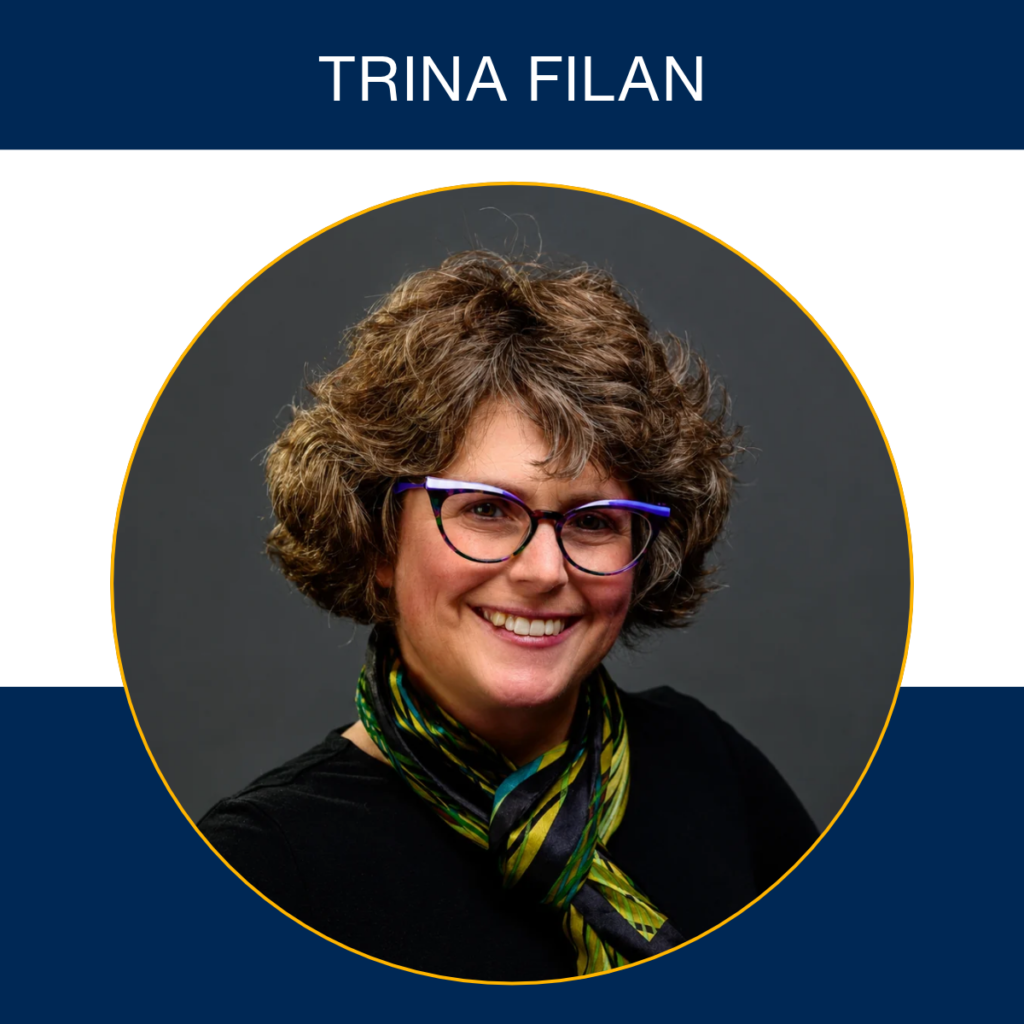
 Trina Filan brings a collaborative approach to public health evaluation, connecting programs with partners who can help expand their reach and impact. In Montana, her work includes strengthening connections with rural and frontier communities and building referral networks that support diabetes self-management and cardiovascular health.
What inspired you to work in this area of public health/chronic disease prevention?
I stumbled into both public health and evaluation accidentally. I have an academic research background (feminist agricultural geography) and transitioned into local nonprofit work focusing on collective impact and upstream socioeconomic issues about 10 years ago. When my current job popped onto my radar in 2018, I looked more deeply at my past work and realized that a lot of it was evaluation related. It was a real “a-ha” moment.
I also had no formal public health training before I took this position. When I got this job, I was excited to learn that a bunch of my past work had been indirectly connected to public health: community development, addressing the social determinants of health, centering silenced voices, and building collaborations to address upstream challenges while maintaining downstream services. When I was hired, I immediately took advantage of the zillions of online trainings available to get up to speed on public health, which was very helpful.
What is one accomplishment or initiative you’re especially proud of in your current role?
In my former nonprofit role doing collective impact work, I made a lot of fruitful connections with other organizations working toward similar goals. I’ve brought that connective energy into this role and focused it through the lens of evaluation, asking, “How can we improve this project’s reach, approach, and impact if we work in partnership with this-or-that organization?” I work closely with another colleague to foster these potentially mutually useful relationships, and now we work closely with the Montana State Library, the Montana Arts Council, the Montana Health Network, and other partners we had no connection with in the past. These connections have bolstered both the Montana Cardiovascular Health and Diabetes Programs, but we try to connect as many Bureau programs as possible to these partners.
How does your work make a difference for people or communities you serve?
The programs I work with have been purposefully increasing their focus on and connections with rural and frontier areas of the state, especially in places where we haven’t done a lot of projects. A colleague of mine and I have taken road trips, given presentations, and built relationships with a lot of new folks. These efforts have increased our reach to new towns and clinics and have helped us to modify our projects to be more inviting for remote and limited-capacity partners.
What is one priority or focus area you’re currently working on?
A couple of years ago, the Montana Diabetes Program got involved in Cohort 2 of the Bright Spot Initiative (BSI), ). A terrific partner, the Montana Health Network, joined us and together we aimed at improving referrals to DSMES throughout eastern Montana, which is a very frontier area with lots of space and drive time between healthcare services. That project has evolved this year to include cardiovascular health quality improvement and building a bi-directional referral network, so it’s suddenly very big and overwhelming, but also could be very cool.
What motivates you to continue this work?
There are so many reasons I find this work worth continuing: my passionate, smart, capable colleagues who do imaginative, interesting work every day, even when the future of the field is in flux; every external partner with the vision to see the ripe fruit in the seed of a proposed idea and the institutional backing to say, “Yes! Let’s try that!”; the feeling of success when one of those “Let’s try that” ideas takes off.
What’s one thing that others might not realize about the impact of your field?
Public health is like the mycorrhizal mat beneath a thriving forest floor. It’s hidden from everyone’s view, but it’s absolutely integral to the well-being of the system. Public health is taken for granted in the same way a healthy mycelial network is, and without it, preventable catastrophes small and large start to happen.
What do you value about your NACDD membership?
I’ve had some of the most fun, informative, and transformative moments of my public health career through NACDD-organized opportunities, from webinars and GEAR Groups (don’t even get me started about GEAR Groups!! WOOT!!), to the CVH Council and the Bright Spot Initiative. NACDD is such a good way to meet colleagues in other states, a conduit for connection to people doing the same work through different lenses. I cannot overstate the value and joy NACDD staff and contractors have brought to my professional experience.
Anything else you would like to share that helps to tell your story or advice for new public health professionals?
Build a diverse skill set. Say yes to as many training and networking opportunities as you can fit into your work life. Go meet the people you don’t know yet – they could be the ones who guide you best. Seek out and build partnerships with libraries, arts and artists, Cooperative Extension, faith communities, schools, city planners, local nonprofit networks, and all the other folks who are part of a healthy civic ecosystem. Don’t freak out if the path is winding and very, very bumpy. There are snacks and canteens available to refresh you, and you have many comrades to chat with along the way.