
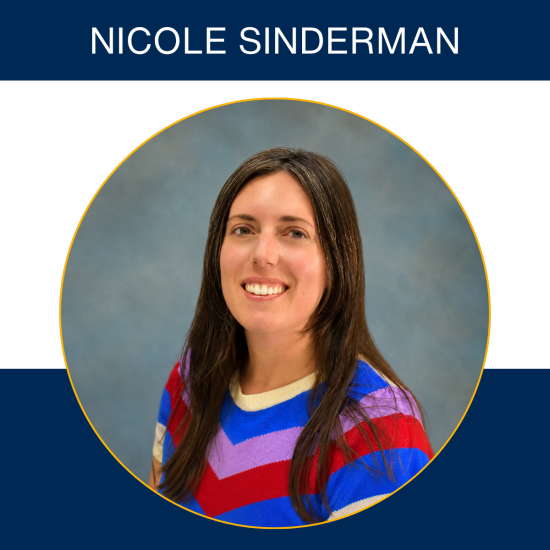
Nicole Sinderman
Tobacco Prevention and Control Program Manager
Missouri Department of Health and Senior Services
NACDD is pleased to highlight Nicole Sinderman, whose commitment to tobacco prevention and control in Missouri reflects both a deep understanding of community needs and a dedication to improving youth health outcomes. With a career shaped by early awareness of the impact of tobacco use, Nicole has focused her work on addressing the systems, partnerships, and social factors that influence prevention and cessation. Through her leadership at the Missouri Department of Health and Senior Services, she continues to advance collaborative strategies that strengthen prevention efforts, including supporting schools as an important setting to reach and protect young people.
What inspired you to work in this area of public health/chronic disease prevention?
I grew up in a rural community where tobacco use was a social norm. All my friends growing up started smoking in middle school or high school. When I went to sleepovers and playdates, their parents smoked in the house and in the car. When I left home for college, I noticed that new friends from higher income backgrounds and urban areas didn’t smoke and wondered what that was about. I knew it wasn’t because my hometown friends weren’t smart or didn’t know the risks. It would be years before I learned about tobacco industry marketing, lobbying, and the social determinants of health, but I knew something wasn’t right.
What is one accomplishment or initiative you’re especially proud of in your current role?
I am proud of the partnerships we have established through the Missouri Tobacco Prevention and Control Strategic Plan workgroup. Our program convenes the workgroup and provides facilitation and administrative support, but it’s really owned by all its members. Participants range from local public health departments to national nonprofit organizations. The workgroup provides an opportunity for partners who were previously working in silos to collaborate around youth prevention, cessation, and eliminating exposure to secondhand smoke and vape aerosol in our state. Partly as a result of these partnerships, a local health department, the Cooper County Public Health Center, received the National Association of County and City Health Officials (NACCHO) Promising Practice Award for its School-Based Tobacco, Vape, and Substance Use Prevention Initiative. I will not take credit for the hard work by the health department, but it was great to see how workgroup partnerships and collaborative efforts have grown and contributed to public health outcomes.
How does your work make a difference for people or communities you serve?
Because we work with and provide resources to organizations that serve communities rather than direct services, sometimes we don’t always get to witness the direct impact we have on citizens. However, I’m always reminded of our impact when we compile outcomes for monthly and annual reports. For example, in our last grant year, we protected 31,913 citizens from secondhand smoke and vape aerosol through new smoke-free and tobacco-free policies in communities, in multi-unit housing, behavioral health facilities, and college campuses. In addition to protecting those citizens from secondhand smoke, these new smoke-free and tobacco-free environments will change the social norm in our state around tobacco use, help people quit, and prevent youth use.
What is one priority or focus area you’re currently working on?
We are concerned about Missouri’s youth tobacco use rates; we’re falling behind the rest of the country. Nearly a quarter of Missouri youth (24%) have smoked a cigarette compared with 14% of national youth. 21% of Missouri youth currently vape compared with 17% of national youth. Missouri schools have tobacco-free policies, but there are gaps in evidence-based prevention education, cessation, and supportive discipline.
In response to this, our program will provide more support to schools to address youth use in the school environment through a new program in partnership with NACDD, the American Academy of Pediatrics, and the Missouri Chapter of the American Academy of Pediatrics. The first cohort of the new Preventing Youth Vaping in Schools Training, Education, Assistance, Mentorship & Support (TEAMS) program will include 12 schools serving 4,017 students.
We also work with Rescue Agency to reach youth through Next to Rise, a youth-led program that gives high school students an opportunity to learn leadership skills and educate their communities about evidence-based tobacco prevention.
What motivates you to continue this work?
I want to see a tobacco-free generation in Missouri. It’s easy to get burned out in public health. However, our partnerships keep me going. The road is long, and it takes a lot of endurance. Sometimes outcomes from our efforts can take years to come to fruition. Our field is under-resourced, but we have strengths in our relationships and shared goals. There are so many dedicated people in our state who continue to keep up the fight and keep us moving in the right direction.
What’s one thing that others might not realize about the impact of your field?
Before entering this field, I had no idea how much effort went into the progress we have seen in tobacco prevention over the past few decades. Without the sustained effort of tobacco control advocates, millions more lives would have been lost over the past 50 years, and we would still be breathing in secondhand smoke on airplanes and in other public places. It’s estimated that tobacco control is associated with the avoidance of millions of premature deaths and estimated extended mean lifespan of 19-20 years. Even with all the progress made, tobacco use is still the leading cause of preventable death in our country. The tobacco industry is always finding new ways to appeal to youth and keep people addicted. It will require a sustained effort by tobacco control advocates to maintain and continue the progress that has been accomplished.
Any advice for new public health professionals?
My advice to new public health professionals is to pace yourself. The goals in public health can seem overwhelming and even intimidating, but it’s just regular people working together to do the right thing and taking it one step at a time. Set small goals along the way and take it one day at a time. Take time for you and set boundaries between life and work. Getting burned out is not going to help you or your community. We need people in this field who are in it for the long haul.
Nicole’s work continues to expand opportunities for collaboration, strengthen youth-focused prevention efforts, and support policies that protect communities from the harms of tobacco use. Her efforts highlight the importance of sustained commitment and partnership in driving meaningful, long-term public health progress.