









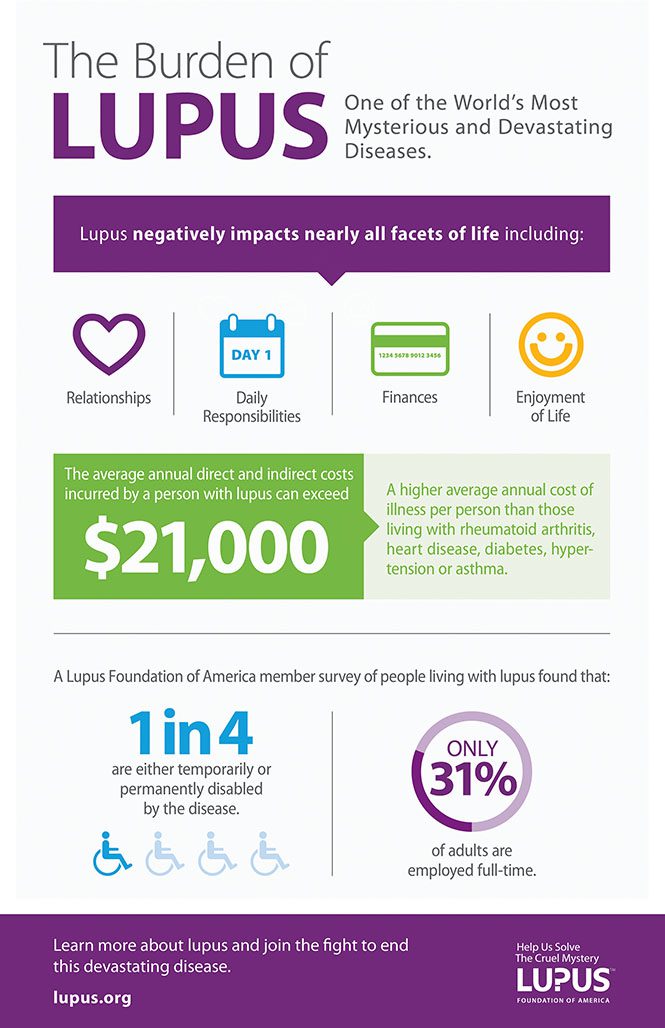



For more than 10 years, NACDD has partnered with the Lupus Foundation of America (LFA), the American College of Rheumatology (ACR), and other partners, to offer education and resources to increase knowledge and understanding of lupus with the goal of improving early diagnosis, patient care, and coordination with specialists. Beginning with the National Public Health Agenda for Lupus 2015, NACDD and LFA have collaborated to educate and facilitate State Health Departments in taking actions to improve the care and quality of life for people living with lupus.
Systemic lupus erythematosus (SLE) is the most common type of lupus diagnosed in children and adults. In SLE, an unknown trigger causes the immune system to attack a person’s own tissues, which can lead to severe kidney disease, stroke, and premature cardiovascular disease.
On average, it takes nearly six years for people with lupus to be diagnosed from the time they first notice their lupus symptoms. While lupus can be debilitating and potentially fatal, in many cases, its health effects can be managed through medical treatment and lifestyle changes.
There are many challenges in reaching a lupus diagnosis because many symptoms mimic the symptoms of other autoimmune diseases.
There is no single diagnostic test for SLE.
A medical provider can complete lab tests to diagnosis the specific type of lupus and severity of the condition.
It is not uncommon for someone to see multiple specialists over several years before receiving a lupus diagnosis.
Lupus is typically diagnosed by a rheumatologist, dermatologist, or a nephrologist.
According to the Lupus Foundation of America, an estimated 1.5 million Americans have been diagnosed with some form of lupus. Lupus affects men and women; however, nine out of every ten individuals diagnosed with lupus are women between the ages of 15 and 44.
Childhood-onset systemic lupus erythematosus is lupus identified in a child before the age of 16. It is also called juvenile systemic lupus erythematosus or pediatric lupus.
Lupus unevenly affects racial and ethnic minorities in comparison to the number or percentage of people diagnosed with lupus among non-minority populations.
Given the complexity of the disease, many people are not diagnosed with Systemic Lupus Erythematosus until adulthood.
There is no cure for lupus, but treatment is available to manage the disease.
Reducing the time to diagnosis helps people with lupus get the right treatment sooner and avoid serious symptoms and complications such as organ damage.
The Exact Cause of Lupus is not Known but may Involve One or More of the Following Factors:
Source: American College of Rheumatology (ACR)
Many health departments do not have resources for a dedicated lupus program. Listed below and under the “Resources” tab on this webpage is information and tools you can use and share as appropriate. If you have a question about lupus or need technical assistance for a lupus initiative or marketing campaign, contact the Lupus Foundation of America at info@lupus.org.
The following NACDD webinar recordings include discussions on the development of the National Public Health Agenda for Lupus, an overview of lupus initiatives led by the American College of Rheumatology and Lupus Foundation of America, and public health efforts in the fight against chronic autoimmune conditions.
The NACDD and the Lupus Foundation of America discuss public health actions on chronic autoimmune conditions.
Presenter: Dr. Melicent Miller, Lupus Foundation of America
Representatives from CDC, ACR, LFA, and NACDD discuss independent and collaborative efforts in the fight against lupus.
NACDD representative Leslie Best provides a broad overview of the national public health agenda for lupus. This webinar also features Dayani Tipple, Director of Disease Awareness Marketing for GlaxoSmithKline Immunology, who discusses disease awareness and educational resources available for professionals and patients.
Presenters: Leslie Best, NACDD Senior Public Health Consultant and Dayani Tipple, Director of Disease Awareness Marketing for GlaxoSmithKline Immunology

Lorem ipsum dolor sit amet, consectetur adipiscing elit, sed do eiusmod tempor incididunt ut labore et dolore magna aliqua. Ut enim ad minim veniam, quis nostrud exercitation ullamco laboris nisi ut aliquip ex ea commodo consequat. Duis aute irure dolor in reprehenderit in voluptate velit esse cillum dolore eu fugiat nulla pariatur. Excepteur sint occaecat cupidatat non proident, sunt in culpa qui officia deserunt mollit anim id est laborum..
Lorem ipsum dolor sit amet, consectetur adipiscing elit, sed do eiusmod tempor incididunt ut labore et dolore magna aliqua. Ut enim ad minim veniam, quis nostrud exercitation ullamco laboris nisi ut aliquip ex ea commodo consequat. Duis aute irure dolor in reprehenderit in voluptate velit esse cillum dolore eu fugiat nulla pariatur. Excepteur sint occaecat cupidatat non proident, sunt in culpa qui officia deserunt mollit anim id est laborum.



Lorem ipsum dolor sit amet, consectetur adipiscing elit, sed do eiusmod tempor incididunt ut labore et dolore magna aliqua. Ut enim ad minim veniam, quis nostrud exercitation ullamco laboris nisi ut aliquip ex ea commodo consequat. Duis aute irure dolor in reprehenderit in voluptate velit esse cillum dolore eu fugiat nulla pariatur. Excepteur sint occaecat cupidatat non proident, sunt in culpa qui officia deserunt mollit anim id est laborum.
Importance of Understanding Lupus
Systemic lupus erythematosus (SLE) is the most common type of lupus diagnosed in children and adults. In SLE, an unknown trigger causes the immune system to attack a person’s own tissues, which can lead to severe kidney disease, stroke, and premature cardiovascular disease.
On average, it takes nearly six years for people with lupus to be diagnosed from the time they first notice their lupus symptoms. While lupus can be debilitating and potentially fatal, in many cases, its health effects can be managed through medical treatment and lifestyle changes.
There are many challenges in reaching a lupus diagnosis because many symptoms mimic the symptoms of other autoimmune diseases.
There is no single diagnostic test for SLE.
A medical provider can complete lab tests to diagnosis the specific type of lupus and severity of the condition.
It is not uncommon for someone to see multiple specialists over several years before receiving a lupus diagnosis.
Lupus is typically diagnosed by a rheumatologist, dermatologist, or a nephrologist.
According to the Lupus Foundation of America, an estimated 1.5 million Americans have been diagnosed with some form of lupus. Lupus affects men and women; however, nine out of every ten individuals diagnosed with lupus are women between the ages of 15 and 44.
Childhood-onset systemic lupus erythematosus is lupus identified in a child before the age of 16. It is also called juvenile systemic lupus erythematosus or pediatric lupus.
Lupus unevenly affects racial and ethnic minorities in comparison to the number or percentage of people diagnosed with lupus among non-minority populations.
Given the complexity of the disease, many people are not diagnosed with Systemic Lupus Erythematosus until adulthood.
There is no cure for lupus, but treatment is available to manage the disease.
Reducing the time to diagnosis helps people with lupus get the right treatment sooner and avoid serious symptoms and complications such as organ damage.
Many health departments do not have resources for a dedicated lupus program. This webpage provides information and tools you can use and share as appropriate. If you have a question about lupus or need technical assistance for a lupus initiative or marketing campaign, contact the Lupus Foundation of America at info@lupus.org.
Lupus is a complex, chronic, inflammatory, autoimmune disease in which an unknown trigger causes the immune system to attack a person’s own tissues, which can lead to severe kidney disease, stroke, and premature cardiovascular disease.
On average, it takes nearly six years for people with lupus to be diagnosed from the time they first notice their lupus symptoms. While lupus can be debilitating and potentially fatal, in many cases its health effects can be managed through aggressive medical treatment and lifestyle changes.
There are many challenges in reaching a lupus diagnosis because so many symptoms mimic other diseases. The path to a diagnosis is further complicated because there is no single diagnostic test for lupus. Reducing the time to diagnosis helps people with lupus get the right treatment sooner and avoid serious symptoms and complications such as organ damage.
Many health departments do not have resources for a dedicated lupus program. This webpage provides information and tools you can use and share as appropriate.
The Lupus Foundation of America (LFA) is an advocacy organization whose mission is devoted to putting an end to lupus, a chronic and potentially fatal autoimmune disease, while giving caring support to those who suffer from its brutal impact
More information about lupus can be found at lupus.org.
The Lupus Foundation of America is a trusted resource for your patients – they provide education and support services to all people affected by lupus. You can share the tools and resources with your state health department, disseminate to public health partners, and refer people with lupus directly to the Lupus Foundation to find easy-to-use information, programs and resources to help them navigate every step of their journey with lupus.
Read the National Public Health Agenda for Lupus 2015 to become familiar with lupus and the public health actions State Health Departments can take to improve the care and quality of life for people living with this disease.
The Lupus Information Packet is a great place to start, it includes information on what to do if someone thinks they might have lupus, a worksheet to explain lupus to others, information on what to do if you are diagnosed with lupus and a symptom checklist. The packet also provides fact sheets on the following topics:
The 5-part Lupus fact sheet series is a great resource for newly diagnosed patients and also available in Spanish. Download here or follow the link for more in-depth information.
A variety of LFA resources are available in Spanish:
The Lupus Foundation of America is dedicated to providing support no matter where your patients live.
Find local events, news and more for you and your patients.
This program is funded through the Centers for Disease Control and Prevention (CDC) Cooperative Agreement #NU58DP006907 in partnership with the Lupus Foundation of America. The content is solely the responsibility of the authors and does not necessarily represent the official views of the CDC.